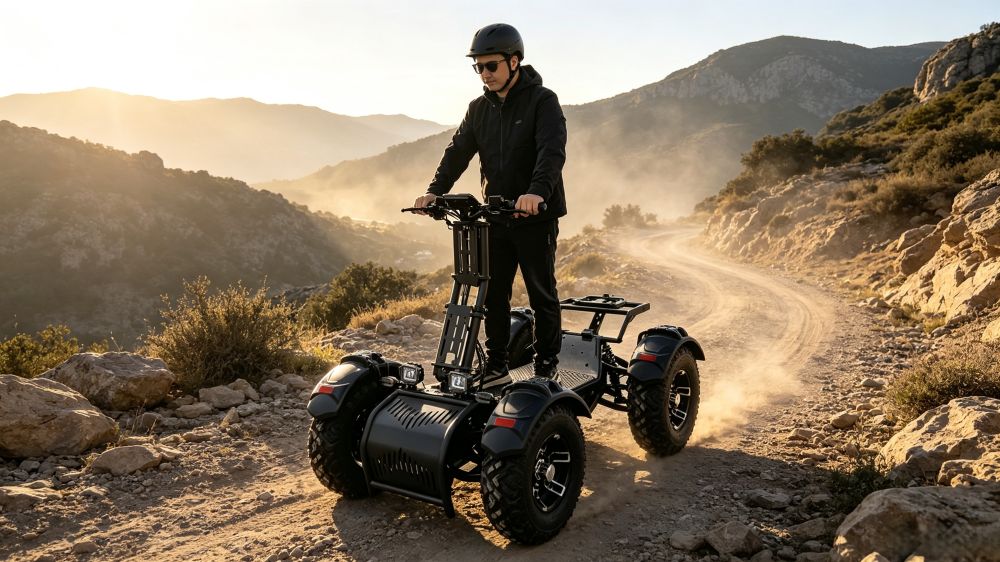
Look, I’ve ridden my fair share of electric scooters. The little commuter ones that top out at 15 mph and shake your fillings loose on anything rougher than a parking lot. The “off-road” models that claim they can handle dirt but fold like a cheap lawn chair the second they hit an actual trail. So when I got my hands on the i-X5 All-Terrain 4×4 Off-Road Electric Scooter, I was skeptical. Really skeptical.
But here’s the thing: I spent three solid days putting this machine through everything I could throw at it — deep mud ruts, loose gravel hills, overgrown grass fields, rocky creek beds, and even some sandy patches after a rainstorm. And I walked away genuinely impressed. Not “well, it’s okay for an electric” impressed. I’m talking “this thing might actually change how we think about off-roading” impressed.
Let me walk you through exactly what happened.
First Impressions: This Thing Is Built Different
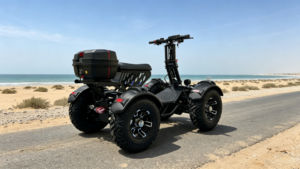
When the i-X5 showed up at my buddy’s farm in a wooden crate, my first thought was: “That’s not a scooter. That’s a small tank.” At about 205 kg (450 lbs) and dimensions of 1700×1010×1400 mm, this is no lightweight toy. The frame is solid iron — not aluminum, not plastic, but honest-to-goodness iron. The handlebars and brake levers are aluminum alloy where it makes sense to save weight, but the core structure? Built to take a beating.
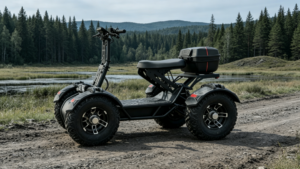
The 21-inch all-terrain tubeless tires are the first thing that catch your eye. These aren’t the skinny little 10-inch wheels you see on regular e-scooters. These are proper ATV-grade knobby tires, big enough to roll over obstacles that would stop most machines cold. And because they’re tubeless, you don’t have to worry about pinch flats when you’re bouncing through rocky terrain.
But the real magic is under the hood — or rather, inside each wheel. The i-X5 packs four independent brushless hub motors, one in each wheel. Each motor is rated at 1,500 watts continuous, with a combined peak output of 10 kW (about 13.4 horsepower). That’s distributed across all four wheels, not just two. And because each wheel is its own self-contained power unit, there’s no chain, no differential, no driveshaft, no transmission fluid — none of the stuff that usually breaks on gas-powered quads.
I flipped the switch, the waterproof LCD dashboard lit up showing battery level and gear selection, and I twisted the throttle. The response was instant. Not “after a half-second delay” instant. I mean instant instant. Electric motors deliver maximum torque from zero RPM, so the second you touch that throttle, you’re moving. No lag, no revving, no drama. Just pure, quiet power.
Test 1: The Mud Pit — Where Most Machines Die
Let’s start with the gnarliest test first. My buddy’s property has a section near the creek that stays muddy pretty much year-round. After some recent rain, it was basically a soup of thick clay mud mixed with decaying leaves — the kind of stuff that swallows shoes and buries ATV tires up to the axle.
I approached it in 4WD mode, standing up on the deck (more on that riding position later). The i-X5’s 21-inch knobby tires churned for maybe half a second, found grip, and just… pulled through. I could feel the four independent motors working together, each wheel adjusting to the slipperiness in real-time. When my left rear tire started spinning in a slick patch, the other three kept pulling. No drama, no getting stuck, no needing a tow strap.
I went back and forth through that mud section maybe six or seven times, trying different lines, hitting deeper ruts, even stopping mid-mud and accelerating from a dead stop. The i-X5 didn’t care. The sealed hub motors shrugged off the mud and water like it was nothing. I blasted through puddles deep enough to splash over the footrests, and the waterproof electrical systems (rated IP65) handled it without a hiccup.
Here’s what really got me: the silence. On a gas quad, you’d be roaring through that mud, engine screaming, exhaust burbling, probably spooking every animal in a half-mile radius. With the i-X5, it was just the soft whir of electric motors and the schlup-schlup-schlup of tires in mud. I could actually hear birds in the trees while I was riding. It felt less like operating machinery and more like… gliding through nature. One reviewer described it as “riding a cloud that happens to have four-wheel-drive,” and after that mud test, I totally get it.
Test 2: Loose Gravel Hills — The Traction Challenge
Next up was a steep gravel road on the back side of the property. We’re talking about a 25-30 degree incline covered in loose, fist-sized rocks and fine gravel that shifts under your tires like ball bearings. On a 2WD machine, this is where you either make it or you slide sideways and hope you don’t roll.
I hit the bottom of the hill, switched to 4WD (yes, you can toggle between 2WD and 4WD on the fly), and twisted the throttle. The i-X5 dug in and climbed. Not slowly, not hesitantly — it just went. The independent suspension on all four wheels meant that when my left front tire hit a bigger rock and compressed, my right front tire stayed planted and kept pulling. That’s the beauty of independent suspension: each wheel reacts to the terrain on its own, maximizing contact with the ground.
About halfway up, I intentionally slowed to a crawl to see if it would stall or lose momentum. Nope. The 10 kW peak power and instant torque meant I could practically crawl up that hill at walking speed if I wanted to. The vector controller (a 60V 160A dual-control smart system developed by Edge Power) precisely manages power to each wheel, so there’s no wheel spin or loss of traction. It just finds grip and keeps moving.
Going down was just as confidence-inspiring. The mechanical oil hydraulic brakes (front and rear) provided consistent, predictable stopping power. No fade, no mushiness, even after repeated downhill runs. And because the brakes are hydraulic rather than cable-actuated or regenerative, they work the same whether it’s hot, cold, wet, or dry. On a steep gravel descent, that’s the kind of reliability that keeps you from becoming a physics problem.
Test 3: Overgrown Grass Fields — Floating Over the Terrain
After the mud and gravel, the grass field seemed like it would be easy. But here’s the thing about tall, thick grass: it hides everything. Rocks, holes, fallen branches, uneven ground — it’s all buried under that green carpet. And wet grass? That’s basically a slip-n-slide for anything with wheels.
I took the i-X5 across about half a mile of tall grass, some of it nearly knee-high. The 21-inch tires did exactly what they’re designed to do: they floated over the top of the grass rather than plowing through it. The high-elasticity compound absorbed impacts from hidden rocks and roots, so instead of feeling every bump jarring up through the frame, it was more like a gentle thump-thump-thump that the suspension soaked up.
The independent progressive damping shock absorbers are height-adjustable, which meant I could raise the ride height for this kind of terrain, giving me extra ground clearance to clear any unexpected obstacles. And at 55 km/h (about 34 mph) across that field, the i-X5 felt stable and planted — not twitchy or top-heavy like I expected from a machine this tall.
What really struck me during this section was the riding position. The i-X5 lets you choose between standing and seated modes. For the grass field, I was standing up, shifting my weight naturally as the terrain changed. Lean forward for a hidden dip, shift back when the front end climbs over a hump, move side to side in turns. It felt more like snowboarding or surfing than riding a motorized vehicle. The visibility from the standing position is fantastic too — I could see over the grass and spot obstacles way earlier than I could from a seated position.
Test 4: Rocky Creek Bed — The Ultimate Torture Test
Okay, this was the one I was most nervous about. A dry creek bed (mostly dry, anyway — there were still some pools of water) filled with rocks ranging from softball-sized to bigger than a microwave. This is where suspension travel, ground clearance, and frame rigidity get put to the real test.
I dropped the speed way down and picked my line carefully, standing up and using my knees as extra suspension. The i-X5’s iron frame handled the impacts without any creaks, groans, or flexing that made me nervous. Each wheel moved independently over the rocks, keeping the other three in contact with the ground as much as possible. When my left rear dropped into a gap between rocks, my right rear and both front wheels kept pulling me forward.
I even rode through a couple of shallow water crossings — maybe 6-8 inches deep — and the sealed motors and waterproof electronics didn’t miss a beat. The LCD dashboard stayed lit, the throttle responded perfectly, and I emerged on the other side with nothing but wet tires to show for it.
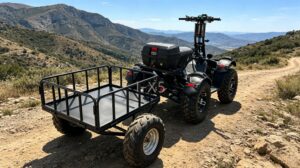
The 300 kg (660 lb) payload capacity came in handy here too. I had about 40 lbs of gear in the rear storage box, plus my own 200 lbs, and the i-X5 didn’t feel overloaded or sluggish. In fact, the extra weight actually seemed to help with traction in some of the trickier rock sections.
The Battery: Range Anxiety? Not Here.
I know what you’re thinking: “Sure, it’s powerful, but how long does the battery last?” Fair question. The i-X5 runs on a 60V lithium iron phosphate (LiFePO₄) battery, available in 50Ah, 60Ah, 70Ah, or 80Ah configurations. I was testing the 60Ah version, which gives you about 3.6 kWh of energy storage and a real-world range of roughly 65-80 kilometers (40-50 miles) under mixed riding conditions.
After three days of hard riding — mud, gravel, grass, rocks, hills, creek crossings, and plenty of full-throttle blasts across open fields — I still had about 30% battery left. And I wasn’t babying it. I was in 4WD most of the time, hitting the throttle hard, climbing steep grades. The LiFePO₄ chemistry is a deliberate choice by Edge Power: it’s safer, handles heat better, and delivers 2,000 to 3,000 charge cycles before you notice any real capacity loss. For a weekend warrior like me, that’s years of riding before I’d even think about replacing the battery.
Charging is dead simple: plug it into a regular wall outlet when you get home, go to bed, and wake up to a full battery 8-10 hours later. No gas station runs, no spilling fuel, no oil changes. One farm owner who reviewed the i-X5 calculated his cost at about $2.60 per 100 miles based on average electricity rates, compared to $23-$35 for his old gas quad. Over time, that savings adds up to serious money.
Stand-Up vs. Seated: Two Machines in One
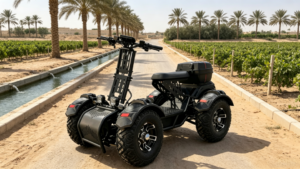
I want to circle back to the riding modes because this is one of my favorite features. Most ATVs force you into a seated position. The i-X5 doesn’t. You can attach the padded seat and ride like a traditional quad, which is great for long distances, hauling gear, or just taking it easy. The seat has a 40-45L storage box behind it, and the handlebar stem telescopes up and down so riders of different heights can dial in their fit.
But honestly? I spent about 80% of my time standing. It just feels more connected. You can see the terrain better, react faster, and use your body weight to help the machine through tricky sections. When you’re standing and the i-X5 is crawling over rocks or pulling through mud, you feel like you’re working with the machine, not just sitting on top of it. It’s more physically engaging, more exciting, and honestly more fun.
And when it’s time to transport? Pop off the seat, collapse the handlebar, and it fits in a standard truck bed or trailer. Try doing that with a 600-pound gas quad without a ramp and a winch.
What About Maintenance? (Spoiler: There Basically Isn’t Any)
Here’s where the i-X5 really separates itself from gas-powered alternatives. No oil changes. No spark plugs. No air filters. No fuel system to clean. No chains to lubricate. No differentials to service. The only “maintenance” I’ve done in three days of hard riding is checking tire pressure and wiping mud off the frame.
The hub motors are sealed units, so dust, mud, and water don’t get inside. The mechanical oil brakes are consistent and reliable. The LiFePO₄ battery has a built-in management system that monitors cell voltage, temperature, and current in real-time, protecting against overcharge, over-discharge, and short circuits. It basically babysits itself.
One reviewer put it perfectly: “I spent more time maintaining my lawnmower last month than I’ve spent on this thing in six months.” I believe it.
The Honest Downsides
Look, no machine is perfect, and I promised you a real review. The i-X5 weighs 205 kg (450 lbs), so you’re not lifting this into a sedan. You need a truck, trailer, or at least a couple of strong friends to move it around when it’s not running. Charging takes 8-10 hours, so if you’re planning a multi-day expedition without access to power, you’ll need to plan accordingly. And it’s not street-legal in most places — this is strictly an off-road machine for private property, farms, hunting grounds, and designated trails.
Also, the upfront cost isn’t pocket change. But when you factor in zero fuel costs, virtually zero maintenance, and a battery that lasts thousands of cycles, the total cost of ownership over a few years makes it a genuinely smart investment.
Final Verdict: The Future of Off-Roading Is Electric (and Quiet)
After three days of beating on the i-X5 All-Terrain 4×4 Off-Road Electric Scooter, I’m a convert. This thing handled mud that would bury most ATVs, climbed gravel hills that would make 2WD machines weep, floated over grass fields like they were paved roads, and crawled through rocky creek beds without breaking a sweat. The four-wheel independent hub motors, the instant torque, the independent suspension, the massive 21-inch tires, and the whisper-quiet operation combine into something that doesn’t just compete with gas-powered quads — in many ways, it surpasses them.
The silence is the game-changer. Once you experience off-roading without the engine roar, without the exhaust fumes, without waking up every animal in the county, it’s hard to go back. You can hear the wind, the birds, the tires gripping the earth. It changes the whole relationship between rider and nature.
If you’re a hunter who needs silent approach. A farmer who needs reliable transport across rough terrain. A weekend warrior who wants serious off-road fun without the maintenance headaches. Or just someone who believes the future of outdoor adventure should be clean, quiet, and ridiculously capable — the i-X5 deserves your attention.
Mud, gravel, grass, rocks, sand, snow — yeah, it handles all of it. And it does it with a grin-inducing, zero-emission, low-maintenance package that makes you wonder why anyone still bothers with gas.