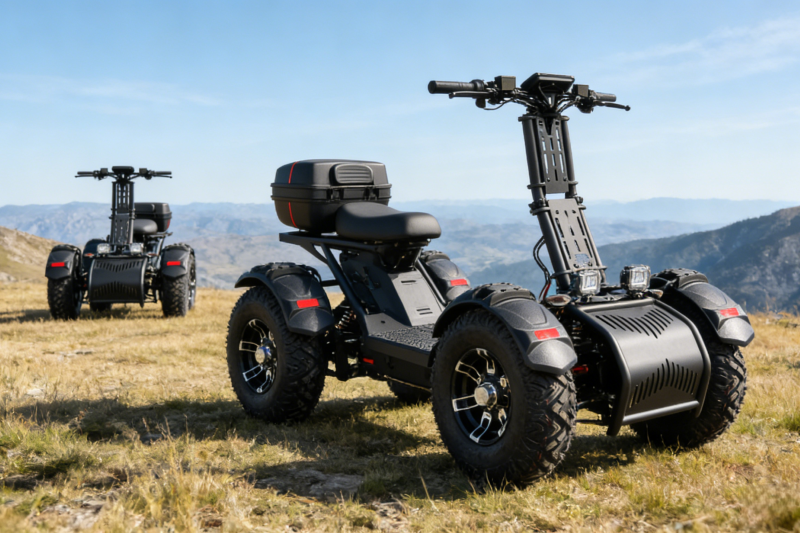
For generations, the rhythm of the hunt has been defined by two sounds: the crack of a rifle and the rumble of a gas-powered ATV. But as the 21st century progresses, a new tension has emerged. Hunters, who are often the greatest conservationists, face increasing restrictions on public and private lands. Noise complaints, soil erosion, and the “motorized vs. non-motorized” debate have locked gates that used to swing wide open.
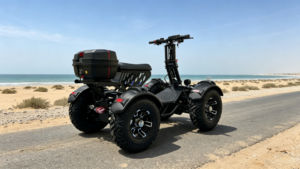
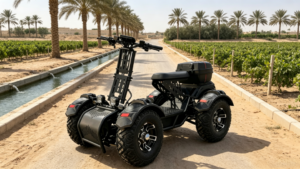
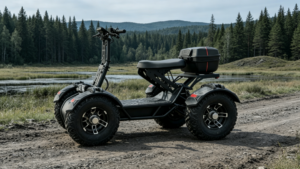
Enter the Electric ATV Scooter. At first glance, it looks like an anomaly—a hybrid of a stand-up scooter and a four-wheeled buggy. But vehicles like the Edgescooter I-X5 are quietly (literally) revolutionizing how hunters access remote terrain, scout for game, and extract harvests. The question is no longer if electric off-road vehicles belong in the hunting world, but rather: Is the Electric ATV Scooter the key to unlocking lost access and creating a new category of leisure hunting?
This deep-dive article explores the mechanics, the ethics, the logistics, and the future of using high-torque electric machines like the I-X5 for hunting and off-road recreation.
Part 1: The Problem with Gas – Why Hunting Access is Shrinking
To understand why the Electric ATV Scooter is gaining traction, we must first look at the landscape of modern hunting. Over the past twenty years, three major trends have closed trails to traditional off-road vehicles (ORVs):
1. Noise Pollution Wars
A gas ATV or UTV operating at 85–100 decibels can be heard from over a mile away across a valley. Non-hunters—hikers, campers, equestrians—have successfully lobbied to ban “loud motorized vehicles” from multi-use public lands. Even on private land, disgruntled neighbors have pushed for local noise ordinances that effectively outlaw early-morning gas ATV use.
2. Soil Erosion and Trail Damage
Heavy gas ATVs (often 400–600 lbs) with aggressive tires can rut out trails, destroy creek banks, and compact soil to the point where water runoff causes erosion. Land managers have responded by closing trails to “wheeled motorized vehicles” indefinitely.
3. Scent and Spook Factor
The smell of gasoline, the cloud of blue smoke from a two-stroke engine, and the vibration of a piston engine travel far beyond the trail. Deer, elk, and turkey learn to associate the sound of a gas engine with human presence. A single ATV ride through a hunting zone can push game off a property for an entire day.
The result? Hunters are walking farther, carrying heavier loads, and leaving their vehicles parked at locked gates miles from their blinds.
Part 2: Enter the Electric ATV Scooter – A New Vehicle Category
The Electric ATV Scooter is not a toy, nor is it a repurposed city commuter. It is a purpose-built machine designed to solve the access problem. The EdgeMoto I-X5 is a prime example of this new category.
Core Specs of the I-X5 (Hunting Context):
- Drivetrain: 4 × 1,500W independent hub motors (10 kW peak / ~13.4 HP)
- Battery: 60V 50Ah–80Ah ternary lithium (3–4.8 kWh)
- Tires: 21″ off-road knobbies (front) / 20″ (rear)
- Payload: Up to 300 kg (660 lbs) – enough for a hunter, gear, and a medium deer or wild hog.
- Weight: ~200 kg (440 lbs) – significantly lighter than a gas ATV.
- Noise Level: ~65 dB – quieter than a normal conversation.
But numbers only tell half the story. The real revolution lies in how these specs translate to field performance.
Part 3: The Silent Stalk – Acoustic Signature and Game Behavior
The most obvious advantage of an Electric ATV Scooter for hunting is silence. The I-X5’s four hub motors produce a high-frequency whine that is directional and dissipates quickly. At 50 feet, it is barely audible. At 100 feet, it is drowned out by wind rustling leaves.
Real-World Hunting Scenario
Imagine you are hunting whitetail deer on a 500-acre farm. With a gas ATV, you must park at the edge of the property by 4:30 AM and walk 45 minutes to your stand in the dark. You arrive sweaty, loud, and potentially leaving a heavy human scent trail.
With an I-X5, you ride silently to within 300 yards of your stand. The deer hear nothing unusual—the scooter is quieter than a squirrel jumping through dry leaves. You step off, walk the last quiet stretch, and climb into your stand. You are fresh, quiet, and you haven’t broadcasted your presence across the property.
Wildlife Response Studies
While formal studies on electric scooters are limited, research on electric vehicles in wildlife reserves shows that animals habituate to EVs much faster than gas vehicles. Zebras, elephants, and antelope in African reserves show mild curiosity followed by indifference to electric safari vehicles, whereas they flee from gas vehicles. By extension, whitetail, elk, and turkey will likely treat the I-X5 as a non-threatening, silent object rather than a predator on wheels.
Part 4: Stealth Mode – Managing Light and Scent
Silence is only one pillar of stealth. The I-X5 offers several features specifically useful for the hunter who values concealment.
Light Discipline
The I-X5 comes equipped with LED headlights and taillights. However, the intelligent controller allows the rider to turn off all lights completely while the scooter remains operational. This is a game-changer for pre-dawn access. You can navigate familiar trails using ambient moonlight or a low-red handheld light without illuminating yourself like a stadium.
Zero Gasoline Smell
Human scent is the number one way deer detect hunters. While you cannot eliminate your body odor, you can eliminate the smell of gasoline, oil, and exhaust fumes that cling to your clothing and gear when using a gas ATV. The I-X5 has no fuel, no combustion, and no hot exhaust pipes to burn your camo pants. You arrive at your blind smelling like the woods, not a mechanic’s garage.
Electric Heat Management
Gas engines throw massive heat. In cold weather, that heat is welcome—but it also melts snow around the vehicle and creates thermal signatures detectable by forward-looking infrared (FLIR) if you are hunting in high-tech predator control scenarios. The I-X5 runs cool. The motors generate some heat, but it is localized to the wheel hubs, not a massive 200°F radiator blasting heat sideways.
Part 5: Accessing “Non-Motorized” Zones – The Legal Gray Area
This is where the Electric ATV Scooter becomes truly controversial—and truly valuable. Many public lands have regulations that distinguish between “motorized” and “non-motorized” vehicles. However, definitions vary wildly.
Where the I-X5 Excels:
- Wildlife Management Areas (WMAs): Many WMAs allow “electric bicycles” and “electric mobility devices” on trails closed to gas ATVs. Because the I-X5 is classified as a scooter (and lacks a traditional seat and handlebar configuration of an ATV), some jurisdictions permit it where a Polaris or Can-Am would be banned.
- State Forests: Several states have adopted “low-impact electric vehicle” exceptions. If the vehicle produces under a certain decibel threshold (e.g., 70 dB) and has a maximum speed under 25 mph, it may be allowed on multi-use trails.
- Private Lease Land: This is the biggest win. Many farmers and timber companies who lease hunting rights explicitly ban gas ATVs due to noise, rutting, and liability. However, they often allow quiet, low-impact electric vehicles. The I-X5, with its independent suspension and wide tires (less ground pressure than a human foot), causes minimal trail damage. Showing up with an electric scooter can be the difference between getting a lease renewal or getting evicted.
The Gray Zone: What to Check
Before you ride, you must check local regulations regarding:
- Definition of “Motorized Vehicle”: Does it include electric?
- Definition of “ATV”: Does a scooter with four wheels legally count?
- Permitted Use: Are “e-bikes” allowed? If yes, the I-X5’s stand-up mode may qualify.
Disclaimer: Always check with your local DNR, Forest Service, or landowner before riding. This article is for informational purposes and does not constitute legal advice.
Part 6: Practical Load-Out – Haunting Gear and Game
A hunting vehicle must do more than just carry a rider. It must haul gear in and game out. The I-X5 is surprisingly capable in this regard.
Payload Capacity
At 300 kg (660 lbs) maximum payload, the I-X5 can comfortably carry:
- Rider (200 lbs / 90 kg)
- Hunting pack, rifle/bow, water, snacks (40 lbs / 18 kg)
- A quartered deer or medium wild hog (150–200 lbs / 68–90 kg)
For larger game like elk, you would still need multiple trips or a trailer, but for most North American whitetail, mule deer, black bear, and hog hunting, the I-X5 has enough capacity.
Cargo Configurations
The I-X5 features a flat deck and front basket options. Clever hunters have added:
- Molle panels on the steering column for attaching pouches (range finder, calls, knife).
- Gun/bow holders (clamp-on fishing rod holders work perfectly).
- Cargo nets over the rear deck to secure a quartered game bag.
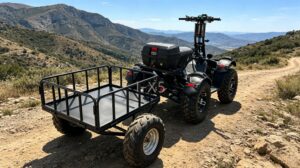
The “Game Cart” Mode
One innovative use: hunters have used the I-X5 to tow a small game cart or sled. Because the electric motors provide instant torque, pulling 100 lbs of gear on a trailer is effortless—and silent. Just ensure your hitch setup does not block the rear hub motor ventilation.
Part 7: Range Anxiety vs. Hunt Duration
The Achilles’ heel of any electric vehicle is range. The I-X5 offers approximately 40–65 km (25–40 miles) of real-world off-road range on a full charge. Is that enough for hunting?
The Math of a Hunt
A typical day hunt involves:
- Morning ride in: 2–5 miles
- Midday scouting loops: 0–3 miles
- Afternoon ride to retrieve game: 2–5 miles
- Evening ride out: 2–5 miles
Total: Rarely more than 15–18 miles (29 km). The I-X5’s range is more than sufficient.
The Long Backcountry Hunt
For multi-day hunts where you are camping out of a truck or base camp, you have two options:
- Solar trickle charge: A 100W solar panel can add 5–10 miles of range per day if left in the sun.
- Spare battery: Some I-X5 configurations allow for quick-swap batteries. Carrying a second 60V 50Ah pack doubles your range to 80 miles—enough for a week of light scouting.
Cold Weather Range Reduction
Lithium batteries lose 20–30% of their effective range in freezing temperatures (below 0°C / 32°F). Plan accordingly. Store the battery inside your tent or truck cab overnight to keep it warm. A cold-soaked battery will show a lower voltage and reduced power output.
Part 8: Maintenance in the Field – Simplicity is Survival
Gas ATVs require fuel, oil, spark plugs, air filters, and coolant. In a remote hunting camp, a broken belt or fouled plug can end your trip.
The I-X5 drastically simplifies field maintenance:
- No oil to check or change.
- No air filter to clog. (Hub motors are sealed.)
- No fuel stabilizer, no stale gas, no carburetor to clean.
- No belt or chain to snap. (Direct hub drive.)
What can break? Tires (bring a plug kit and a portable 12V inflator), brake pads (unlikely in a single trip), and electrical connections (keep dielectric grease and a basic multimeter). Overall, the Electric ATV Scooter is far more reliable in remote conditions than any gas equivalent.
Part 9: The Ethical Discussion – Fair Chase and Technology
We must address the elephant in the room: Is using a silent electric vehicle to get closer to game “fair chase”? The Boone and Crockett Club and various state game commissions have long debated the use of technology in hunting.
The Purist’s Argument
Some argue that any motorized vehicle reduces the “sport” of hunting. They believe hunters should walk, track, and earn their game through physical exertion.
The Access Argument
However, the reality for many hunters—especially those with physical disabilities, age-related mobility issues, or limited time—is that walking 5 miles before dawn is simply not possible. Electric vehicles like the I-X5 democratize hunting. They allow a 70-year-old grandfather or a veteran with a bad knee to access the same backcountry spots as a 25-year-old athlete.
The Conservation Argument
Furthermore, electric vehicles do not leak oil into watersheds, do not start wildfires via hot exhaust pipes on dry grass, and do not scar the land with deep ruts. From a land stewardship perspective, the Electric ATV Scooter is arguably more ethical than a gas ATV.
The Verdict: The I-X5 does not shoot the deer for you. It does not spot the game for you. It simply gets you to the trailhead quietly. The stalk, the shot, the tracking—that remains entirely your skill. Most hunters agree this is a fair and welcome tool, not a cheat code.
Conclusion: The Key is Turning in the Lock
So, is the Electric ATV Scooter, specifically the EdgeScooter I-X5, the key to unlocking new leisure hunting and off-road access?
The answer is a qualified yes.
- It unlocks acoustic access to noise-sensitive lands.
- It unlocks regulatory access where gas ATVs are banned.
- It unlocks physical access for mobility-limited hunters.
- It unlocks ethical access for conservation-minded outdoorsmen.
The I-X5 is not a replacement for a pickup truck or a side-by-side UTV. It is a specialized tool for a specific niche: the hunter who needs to go far, go quiet, and go light. It bridges the gap between walking and driving.
As land access continues to shrink and public pressure against motorized recreation grows, the Electric ATV Scooter may evolve from a niche curiosity into a standard piece of hunting gear—right next to the binoculars, the rangefinder, and the rifle.
The future of hunting off-road access is silent, and the power is roaring. The gate is locked, but the key is in your hands. Twist the throttle. Ride quiet. Hunt smart.