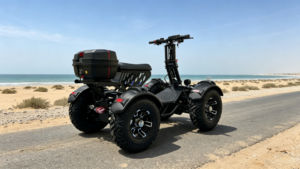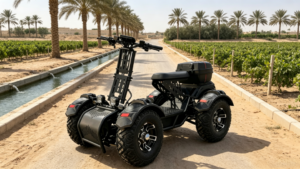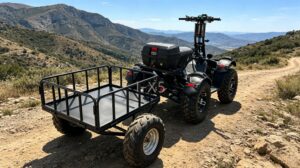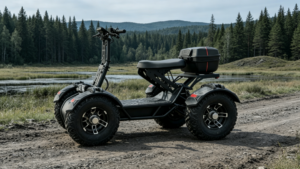
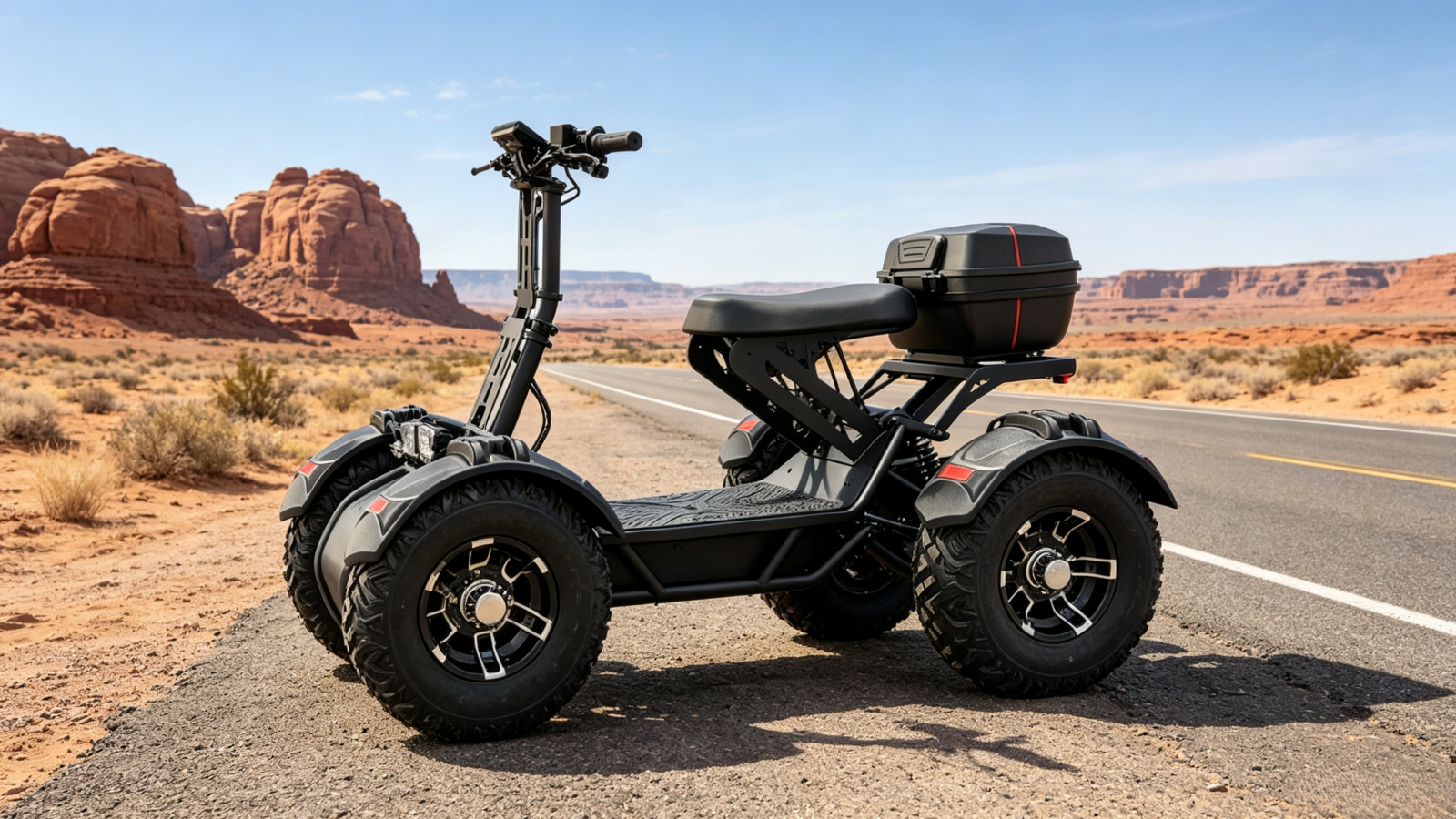
There is something quietly magnificent about Central Asia. The sweeping steppes of Kazakhstan, the towering Tian Shan mountains of Kyrgyzstan, the dramatic Caucasus ranges of Azerbaijan, and the vast wilderness stretching into Russia’s southern regions—these landscapes have captivated travellers and locals alike for centuries. For generations, exploring this terrain meant saddling a horse or, more recently, firing up a petrol-powered quad bike and roaring across the land.
But the winds of change are blowing across the steppes, and they carry no exhaust fumes.
From the shores of Lake Issyk-Kul to the flaming hills of Azerbaijan, from the Kazakh plains to the Russian Caucasus, a quiet revolution is gathering pace. The electric ATV scooter has arrived in Central Asia, and it is redefining what it means to explore some of the world’s most spectacular landscapes.
Welcome to the Edge Scooter era.
Why Central Asia? Why Now?
At first glance, Central Asia might not seem the obvious place for an electric vehicle revolution. But look closer, and the pieces fit together remarkably well.
Abundant Renewable Energy
Kazakhstan and Kyrgyzstan possess enormous hydroelectric potential. Azerbaijan is investing heavily in wind and solar projects. Russia, despite its fossil fuel reputation, has significant renewable capacity in its southern regions. The energy that powers these electric ATV scooters can come from sources as clean as the mountain air itself.
Tourism on the Rise
Central Asian nations are actively developing their tourism sectors. Kazakhstan’s “Visit Kazakhstan” campaign, Kyrgyzstan’s community-based tourism initiatives, and Azerbaijan’s modernisation efforts are drawing increasing numbers of international visitors. These travellers—particularly younger, environmentally conscious ones—are seeking authentic experiences that do not come at the planet’s expense.
Economic Practicality
Fuel costs matter in Central Asia. For tour operators running multiple vehicles daily, for farmers checking remote land, for park rangers patrolling vast territories—the operating cost advantages of electric mobility are compelling. Less maintenance, lower fuel costs, and longer vehicle lifespans translate directly into improved bottom lines.
Preserving Pristine Landscapes
Perhaps most importantly, Central Asia’s landscapes are extraordinarily fragile. Alpine meadows, semi-desert steppes, and mountain watersheds recover slowly from disturbance. The electric ATV scooter offers a way to access these areas with minimal environmental impact—no exhaust emissions, reduced noise pollution, and lighter physical footprint.
Country by Country: The Electric ATV Scooter Takes Hold
Kazakhstan: The Steppe Goes Electric
Kazakhstan is vast—larger than Western Europe—yet its population is smaller than London’s. Getting around this enormous country has always been a challenge. Traditional petrol ATVs have served ranchers, oil field workers, and tour operators for years, but change is in the air.
Around Almaty, adventure tourism companies are beginning to introduce electric ATV scooters for mountain excursions into the Tian Shan foothills. The instant torque of electric motors proves ideal for steep, rocky trails. Tour guides report that clients—particularly international visitors from Europe and East Asia—specifically request electric options.
In the agricultural sector, Kazakh farmers managing large properties are discovering that electric ATV scooters offer a practical solution for daily rounds. Checking livestock, inspecting fences, and monitoring water sources across sprawling properties becomes far more efficient. The vehicles’ quiet operation has an unexpected benefit: animals are less stressed by approaching vehicles, making handling easier and safer.
The government, meanwhile, is supportive. Kazakhstan’s commitment to carbon neutrality by 2060 may seem distant, but concrete steps are being taken now. Incentives for electric vehicles, including reduced import duties and registration fees, are making the transition economically attractive.
Kyrgyzstan: Mountain Mobility, Reimagined
If anywhere in Central Asia was made for the electric ATV scooter, it is Kyrgyzstan. This small, mountainous nation is often called the “Switzerland of Central Asia”—a land of pristine alpine lakes, nomadic traditions, and some of the world’s most spectacular trekking routes.
Community-based tourism is the backbone of Kyrgyzstan’s visitor economy. Families in remote valleys host travellers in traditional yurts, offering horseback rides, hiking guides, and cultural experiences. The addition of electric ATV scooters to this mix is proving transformative.
Imagine arriving at a mountain jailoo (summer pasture) not to the roar of a two-stroke engine but to the gentle whir of an electric motor. The herder’s family comes out to greet you. The eagles circling overhead are undisturbed. The silence of the high mountains remains intact. This is the experience the Edge Scooter makes possible.
For local communities, the benefits extend beyond tourism. Medical outreach workers can reach remote villages more reliably. Teachers can cover larger catchment areas. Emergency services can respond more quickly in terrain where every minute counts.
Kyrgyzstan’s abundant hydroelectric power—much of it generated in the mountains themselves—means these vehicles can be charged with genuinely clean energy. It is a rare case where geography, culture, and technology align so neatly.
Azerbaijan: From Flames to Green Innovation
Azerbaijan occupies a fascinating position. The “Land of Fire” built its modern economy on oil, yet it is now actively diversifying into renewable energy and sustainable tourism. The contrast between ancient petroleum flames at Yanar Dag and modern wind turbines on the Caspian coast tells the story of a nation in transition.
The electric ATV scooter fits neatly into this narrative. Around Baku and the Absheron Peninsula, recreational riding is growing in popularity. The flat coastal terrain and expanding trail networks are ideal for electric vehicles. Local clubs and rental businesses are emerging, catering to both residents and the increasing numbers of visitors discovering Azerbaijan beyond its capital.
In the mountainous north, near Sheki and Quba, the terrain becomes more challenging. Here, four-wheel-drive electric ATV scooters demonstrate their capability on steep, rough tracks. Tea plantation workers, forest rangers, and tourism operators are finding practical applications that go well beyond recreation.
Azerbaijan’s government has announced ambitious renewable energy targets, with plans to develop significant wind and solar capacity. As this clean energy comes online, the environmental credentials of electric mobility will only strengthen.
Russia: The Southern Frontier
Russia’s vastness defies easy categorisation, but its southern regions—the North Caucasus, Southern Siberia, and the Altai Mountains—share characteristics with their Central Asian neighbours. Dramatic mountain landscapes, developing tourism infrastructure, and a growing interest in sustainable outdoor recreation create fertile ground for electric ATV scooters.
In the North Caucasus, where republics like Dagestan, Kabardino-Balkaria, and North Ossetia are promoting mountain tourism, electric vehicles offer a way to develop infrastructure without degrading the environment that draws visitors. The Caucasus Mountains are a UNESCO-recognised biodiversity hotspot; preserving their ecological integrity is essential.
For Russian outdoor enthusiasts, the appeal is both practical and philosophical. The country’s long tradition of dacha culture, forest retreats, and wilderness appreciation aligns naturally with low-impact mobility solutions. An electric ATV scooter that carries you to a remote fishing spot or mountain viewpoint without disturbing the peace is an attractive proposition.
What Makes the Electric ATV Scooter Central Asia-Ready?
Sceptics might question whether electric vehicles can handle Central Asian conditions. The answer lies in thoughtful engineering and regional adaptation.
Cold Weather Performance
Winters in Central Asia are serious business. Temperatures in Kazakhstan and Kyrgyzstan regularly drop below minus twenty degrees Celsius. Modern battery technology, however, has evolved considerably. Thermal management systems, battery preconditioning, and appropriate chemistry selections mean that electric ATV scooters can operate reliably even in harsh conditions. For seasonal tourism operations, this is less of a concern—peak visitor seasons align with milder weather. For year-round agricultural or utility use, proper specification and storage protocols address the challenge.
Rugged Terrain Capability
Central Asian landscapes are not gentle. Rocky mountain trails, loose scree, river crossings, and deep mud are common hazards. The Edge Scooter platform addresses this with robust four-wheel-drive systems, generous ground clearance, and suspension travel designed for genuine off-road use. These are not city scooters with off-road pretensions; they are capable machines built for demanding environments.
Range and Charging Infrastructure
Range anxiety is the most common concern, and it is not without foundation. Central Asia’s charging infrastructure remains limited compared to Western Europe or East Asia. However, several factors mitigate this:
- Modular battery systems allow for quick swaps in commercial settings
- Portable charging solutions enable off-grid operation with solar or generator support
- Route planning that matches vehicle range to operational requirements
- Growing infrastructure as adoption increases and investment follows
For many Central Asian applications—daily farm rounds, guided tours of defined routes, park patrols—the range of modern electric ATV scooters is already more than sufficient.
Durability and Serviceability
Remote operation demands reliability. The Edge Scooter approach emphasises simplicity: fewer moving parts, robust construction, and designs that can be maintained with basic tools and local expertise. In regions where specialist mechanics may be hours away, this practical reliability is not a luxury but a necessity.
The Experience: Voices from Central Asia
The best evidence comes from those already using these machines.
“My guests hear the birds now” — Aigul, Kyrgyzstan
“I run a small guesthouse near Karakol. We take visitors to alpine lakes and mountain viewpoints. When we switched to electric ATVs, the difference was immediate. Before, we would arrive and the engine noise would send all the wildlife into hiding. Now, we see marmots, eagles, even ibex sometimes. My guests say it feels like they are really in the mountains, not just visiting them.”
“The numbers work” — Yerlan, Kazakhstan
“I manage a fleet of vehicles for a hunting and fishing lodge near Astana. We run these machines hard—mud, snow, river crossings, the lot. I was doubtful about electric, honestly. But after running the numbers, the fuel savings alone justified the switch. Maintenance is simpler too. No oil changes, no spark plugs, no carburettor adjustments. My mechanics were sceptical at first; now they are converts.”
“It fits our values” — Rashad, Azerbaijan
“My family has land in the mountains near Sheki. We grow walnuts and keep bees. For years, I used a petrol quad to get around the property. But I started thinking about what I was leaving behind—the smell, the noise, the exhaust settling on my trees. The electric scooter does everything the old machine did, but I feel good using it. That matters to me.”
Transforming Tourism and Livelihoods
The impact of electric ATV scooters extends across multiple sectors.
Eco-Tourism Development
Central Asia’s natural beauty is its competitive advantage in the global tourism market. Preserving that beauty while making it accessible is the central challenge. Electric mobility offers a credible solution. Tour operators can market genuinely low-impact experiences, appealing to the growing segment of travellers who factor environmental responsibility into their choices.
Agricultural Efficiency
For farmers and pastoralists across the region, daily mobility is essential. Checking herds, inspecting crops, maintaining infrastructure across large, often rugged properties—these tasks demand reliable transport. The electric ATV scooter reduces both the cost and the environmental impact of this necessary travel.
Conservation and Research
Park rangers, biologists, and environmental monitors need to cover extensive, often sensitive areas. Quiet, emission-free vehicles allow closer observation of wildlife without disturbance. In a region where snow leopards, Marco Polo sheep, and other rare species still roam, this capability is genuinely valuable.
Community Services
Remote communities across Central Asia face familiar challenges: accessing healthcare, education, and emergency services. While electric ATV scooters are not a panacea, they offer a practical mobility solution in areas where conventional vehicles struggle with terrain or fuel supply.
The Edge Scooter Approach
In an emerging market, quality and support matter enormously. The Edge Scooter philosophy centres on delivering not just vehicles but complete solutions.
Regional Adaptation
Vehicles designed for European or North American conditions often fail in Central Asia. The Edge Scooter platform is specified with regional realities in mind: temperature extremes, dust and sand, rough terrain, and limited service infrastructure.
Commercial Partnerships
Successful adoption requires more than selling machines. It means building relationships with local operators, training technicians, establishing parts supply chains, and providing ongoing support. The Edge Scooter model invests in these partnerships, recognising that long-term success depends on local capability.
Flexible Configuration
Different users have different needs. A tourism operator in Kyrgyzstan requires different specifications from a Kazakh agricultural user or an Azerbaijani resort. The Edge Scooter platform offers configurations that match these varied requirements—cargo capacity, passenger seating, range optimisation, and terrain-specific modifications.
Overcoming Hurdles
Honest assessment requires acknowledging challenges.
Infrastructure Limitations
Charging infrastructure in Central Asia remains underdeveloped outside major cities. Solutions include portable charging equipment, solar integration, battery swap programmes, and phased infrastructure investment tied to adoption growth.
Initial Cost Barriers
Electric vehicles typically command higher upfront prices. However, total cost of ownership calculations—factoring fuel savings, reduced maintenance, and longer operational life—strongly favour electric for high-utilisation applications. Financing mechanisms and gradual fleet replacement strategies can ease the transition.
Cultural Familiarity
Petrol engines are familiar; electric drivetrains are not. Demonstration programmes, trial periods, and visible success stories are essential for building confidence. Early adopters become ambassadors, and word travels fast in tight-knit communities.
Looking Forward
The trajectory is clear. As battery technology continues improving, as charging infrastructure expands, and as environmental awareness grows, the case for electric ATV scooters in Central Asia will only strengthen.
We can anticipate:
- Growing tourism fleets in Kazakhstan’s mountain resorts and Kyrgyzstan’s jailoo communities
- Agricultural adoption spreading as farmers recognise economic advantages
- Government support increasing as national sustainability commitments translate into concrete programmes
- Regional manufacturing or assembly emerging as markets mature
- Cross-border cooperation on standards and infrastructure
Central Asia has a chance to leapfrog the petrol-dependent phase that characterised outdoor mobility elsewhere, moving directly to cleaner, smarter solutions.
The Landscape Calls
Central Asia’s mountains, steppes, and valleys have witnessed millennia of human passage. Nomadic horsemen, Silk Road caravans, Soviet-era explorers, and modern adventurers have all crossed this terrain. Each generation found its own way to move through these landscapes.
The electric ATV scooter represents the next chapter. It honours the spirit of exploration that defines Central Asia while respecting the fragility of its ecosystems. It offers practical benefits for those who make their living from the land while preserving that land for future generations.
The Edge Scooter is not merely a vehicle. It is a statement of intent—a declaration that progress and preservation can advance together, that adventure need not come at environmental cost, and that Central Asia’s extraordinary landscapes deserve extraordinary care.
The mountains are waiting. The steppes stretch to the horizon. The eagles still circle overhead.
And now, you can meet them quietly.
Welcome to the future of Central Asian mobility. Welcome to the Edge Scooter experience.