The off-road world is undergoing a seismic shift. For decades, the roar of a two-stroke or four-stroke engine was the undisputed soundtrack of adventure. However, a new era is dawning—one characterized not by silence, but by the subtle, high-frequency whine of electric motors and the crunch of tires on gravel. The future of all-terrain exploration is silent, yet ironically, the power has never been louder.
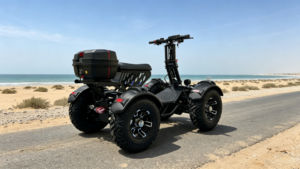
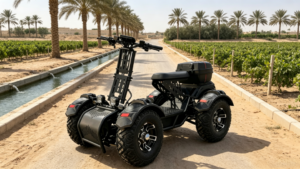
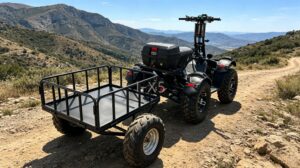
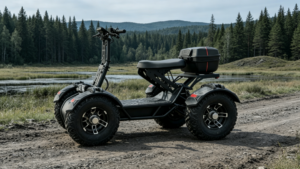
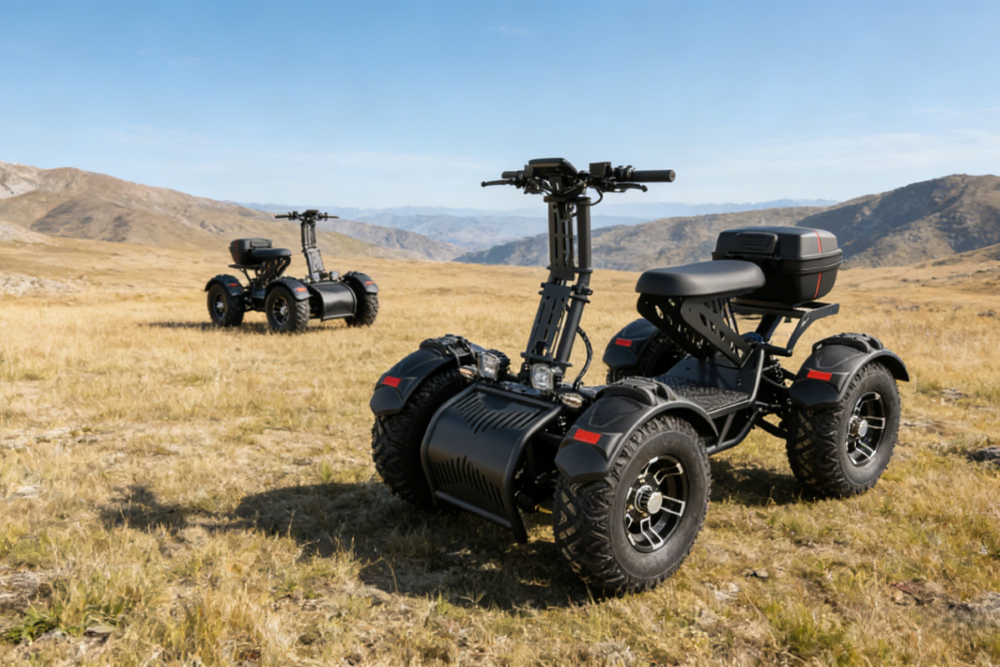
Enter the Electric ATV Scooter. This emerging vehicle category merges the compact agility of a scooter with the rugged durability of an All-Terrain Vehicle (ATV). Leading this charge are machines like the Edgescooter I-X5, a vehicle that looks like it was pulled from a sci-fi film but is built for the muddiest backwoods trails.
To the uninitiated, an electric ATV scooter might seem like a toy. But looking at a spec sheet filled with terms like kW, kWh, and N.m can be intimidating. If you don’t understand what these numbers mean, you might end up with a machine that either lacks the guts to climb a hill or has so much power it becomes dangerous.
This guide will decode the technical jargon, explaining exactly how to evaluate the heart (motor), lungs (battery), and muscles (torque) of these silent beasts, using the I-X5 as our benchmark for modern engineering.
1. The Heart of the Beast: Understanding kW and Motor Configuration
In the world of gas engines, we talk about horsepower (HP) and displacement (cc). In the electric world, the king of the hill is the Kilowatt (kW) . One kilowatt is roughly equivalent to 1.34 horsepower. But unlike a gas engine, which needs to rev high to hit its peak power, an electric motor delivers its grunt instantly.
Continuous vs. Peak Power
When shopping for an Electric ATV Scooter, you will often see two numbers: Rated Power and Max Power.
- Continuous Power (Rated): This is the wattage the motor can handle indefinitely without overheating. It is the “cruising” capability.
- Peak Power (Max): This is the short-burst output for acceleration, climbing steep hills, or blasting through deep sand.
For a vehicle like the I-X5, the specs are particularly impressive because of its configuration. Unlike a standard scooter with one motor in the wheel or a basic ATV with one central engine, the I-X5 utilizes a 4×1,500W brushless hub motor setup. This means there is a dedicated 1.5kW motor inside each of the four wheels.
Mathematically, this results in a combined peak output of approximately 10,000 watts (10 kW) , or roughly 13.4 horsepower. While that number might sound modest compared to a 50hp gas ATV, remember the instant delivery and weight distribution. A 10kW electric vehicle often feels quicker off the line than a 15kW gas vehicle because peak torque is available at 0 RPM.
Why “Hub Motors” Matter for the I-X5
By placing the motor in the wheel (hub motor), the I-X5 eliminates the need for drive shafts, chains, or belts running between the wheels. This reduces mechanical drag and frees up space for the battery. More importantly, it allows for precise electronic control of each wheel—essentially giving the scooter a digital “locking differential” ability that mechanical vehicles can only dream of.
2. The Lungs: Decoding Battery Capacity (kWh and Ah)
You can have a 20kW monster of a motor, but if the battery is tiny, you’ll only enjoy that power for ten minutes. Range anxiety is the biggest hurdle for electric off-roading. To understand range, you must understand kWh (Kilowatt-hours) and Ah (Amp-hours).
A simple analogy: Voltage (V) is the pressure of the water, Amp-hours (Ah) is the size of the water tank, and Watt-hours (Wh) is the total amount of water.
The Formula: Voltage (V) × Amp-hours (Ah) = Watt-hours (Wh)
The I-X5 offers a spectrum of battery options, ranging from a 60V 50Ah system up to an 80Ah system.
- Entry Calculation: 60V × 50Ah = 3,000 Wh (or 3 kWh).
- Upgrade Calculation: 60V × 80Ah = 4,800 Wh (4.8 kWh).
To visualize this, consider a high-end electric bicycle might have a 0.5 kWh battery. A Tesla has a 75–100 kWh battery. A serious Electric ATV Scooter like the I-X5 sits right in the middle at 3–5 kWh. This translates to a real-world range of approximately 40 to 65 kilometers (25 to 40 miles) depending on terrain and riding style.
The Chemistry: Ternary Lithium vs. Others
It is not just about size; it is about chemistry. The I-X5 utilizes Ternary Lithium cells (NMC – Nickel Manganese Cobalt). Why does this matter to the rider?
- Energy Density: NMC batteries pack a lot of power into a small space, keeping the scooter light enough to maneuver.
- Cycle Life: These batteries typically last for 800–1,000 charge cycles before dropping to 80% capacity. If you ride once a week, that is nearly 20 years of use.
- Cold Weather Performance: NMC handles cold temperatures better than older lead-acid or some other lithium chemistries, which is crucial for winter riding.
3. The Muscle: Torque (N.m) and the “Silent Roar”
If horsepower sells cars (and scooters), torque wins races—and climbs mountains. Torque is the rotational force that twists the wheel. In an electric motor, torque is king because it is available instantly.
Why the I-X5 Feels Like a Rocket
The I-X5 does not have a single torque rating; it has four. Each 1,500W hub motor contributes to a total combined torque that is staggering for a vehicle of its size. While the manufacturer lists the peak output, the feeling is what matters.
Imagine trying to push a heavy sofa across a carpet. A gas engine is like a friend who helps you push, but only after running across the room to get a running start (revving up). An electric motor is a friend standing right behind the sofa, pushing with full force the moment you say “Go.”
This is why the “Silent Roar” is a fitting description. The I-X5 produces immense low-end torque to climb 45-degree inclines without a sound of struggle. There is no downshifting, no engine bogging down, just a smooth, relentless pull.
4. Suspension and Brakes: Managing the Power
Power is nothing without control. A vehicle weighing in excess of 205 kg (450 lbs) with a payload capacity of up to 300 kg (660 lbs) traveling at 55 km/h needs serious stopping power and suspension travel.
Independent Suspension
The I-X5 features front and rear independent swing arms. In layman’s terms, if the left front tire hits a rock, the right front tire stays planted on the ground, unaffected. This is crucial for maintaining traction on uneven trails. For the rider, it means the difference between being thrown off course and gliding over obstacles.
Hydraulic Braking
Since the motors are in the wheels, many cheap electric scooters rely on “electronic braking” (regen) only. The I-X5, however, uses four-wheel hydraulic disc brakes (Mechanical Oil Brakes).
- Why? Because when you are descending a steep, muddy hill, you need mechanical clamping force. Regenerative braking is great for saving battery life, but it is not reliable for emergency stopping. The combination of regen for efficiency and hydraulic discs for safety is the gold standard.
5. The “I-X5” Ecosystem: Smart Features and Practicality
Beyond the raw numbers, the EdgeMoto I-X5 represents the maturity of this market. It is not a barebones prototype; it is a refined product.
Dual-Mode Versatility
One of the unique selling points of the I-X5 is its adaptability. It features adjustable pole height and a removable seat. In five minutes, you can convert it from a stand-up scooter (ideal for technical off-road control and visibility) to a sit-down cruiser (ideal for long-distance comfort or utility work).
The Controller: The Brain
The “kW” and “kWh” are the heart and lungs, but the Controller is the brain. The I-X5 uses an intelligent dual-control system that manages power to all four wheels. This allows for features like:
- Variable Speed Modes: A “Beginner” mode that limits top speed and throttle response, and a “Sport” mode that unleashes the full 10kW.
- Electronic Traction Control: If one wheel spins in the mud, the controller can reduce power to that wheel and send it to the wheels with grip. This is automated, digital muscle.
- Reverse Gear: Essential for maneuvering a heavy scooter out of a tight spot in the woods.
6. The Environmental and Sensory Shift
We cannot discuss the “Future is Silent” without addressing why silence is a feature.
A traditional 150cc ATV operates at around 85–100 decibels (dB). The I-X5 hums at roughly 65 dB. This is quieter than a normal conversation.
For the rider, this lowers fatigue. You don’t arrive at the mountain top with ringing ears and a headache from vibration. For the environment, it is revolutionary. It allows for “stealth camping” and wildlife observation. The I-X5 allows riders to slip through forests without scaring every bird within a 200-meter radius.
Furthermore, the lack of a gas engine means no oil changes, no spark plugs, no air filters, and no fuel stabilizer. The maintenance schedule of an Electric ATV Scooter is drastically simpler than its gas-guzzling ancestor.
Conclusion: Decoding Your Needs
When you look at an Electric ATV Scooter like the I-X5, do not let the futuristic, quiet appearance fool you. The numbers tell the story of a machine with immense capability.
- kW (Power) tells you how fast you can accelerate and climb.
- kWh (Energy) tells you how far you can explore before heading home.
- Torque (N.m) tells you how effortlessly it will bully its way through mud and up cliffs.
The future of off-roading is here. It is heavy-duty lithium batteries wrapped in aluminum frames, propelled by silent hub motors. The future is quiet, efficient, and smart. But make no mistake—when you twist the throttle on an I-X5 and feel those 10,000 watts shove you back into the seat, the power is absolutely roaring.